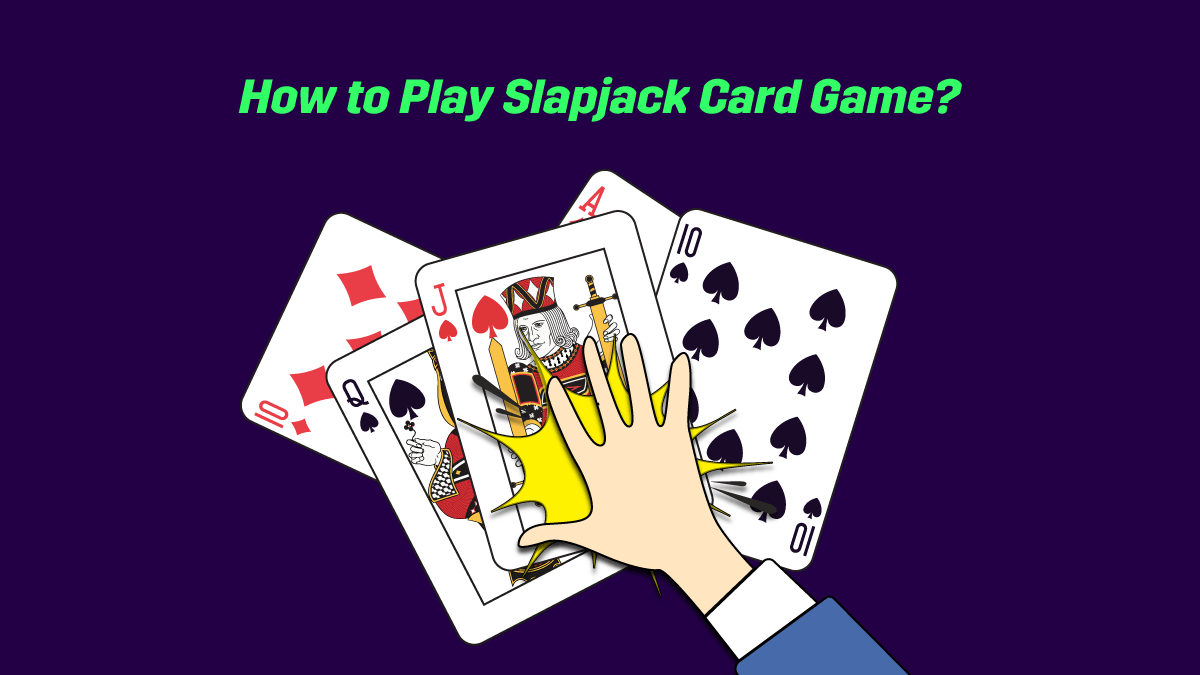
Slapjack is basically a deck-powered reflex test. You’re not building hands or counting tricks. You’re watching a pile like a hawk, waiting for a Jack to appear, and trying to be the first person to slap it before your opponent does. It’s quick, loud, and perfect for people who want a card game that feels like an event instead of a puzzle.
If you’re searching how to play slapjack card game, you’ll find plenty of house rules. The good news: the core version is simple, and it runs smoothly as two player card games once you agree on a couple of fairness details.
The goal
Win all the cards by correctly slapping the pile when a Jack is played.
What you need
-
A standard 52-card deck
-
A clear table space (hands will move fast)
Setup: deal the deck
Shuffle and deal the entire deck evenly between players (26 each). Keep your pile face down. Don’t look at your cards.
Place a shared area in the middle for the face-up pile (the “slap pile”).
How a round works
Players take turns flipping the top card of their pile face up onto the slap pile.
Important: flip cleanly and fully face up so both players can see it. Most groups flip in a steady rhythm.
If the flipped card is not a Jack, play continues to the next player.
If the flipped card is a Jack, anyone can slap the pile. The first correct slap wins the entire slap pile.
The winner takes all cards in the slap pile, turns them face down, and adds them to the bottom of their personal pile. Then play resumes with the next flip.
That’s the engine: flip, watch, slap on Jacks, collect.
What happens if someone slaps incorrectly?
To stop random slapping, most versions use a penalty.
Common penalty rules:
-
If you slap when there’s no Jack, you must give one card from your pile to the slap pile (face up or face down—decide before playing).
-
In some groups, you “burn” a card to the center and lose your next flip.
Pick a penalty that fits your players. With kids, a one-card penalty is enough. With competitive adults, stronger penalties keep it honest.
Winning the game
You win by collecting the entire deck.
But Slapjack can loop for a while because piles recycle. If you want a cleaner session, use a time limit (like 10 minutes) and declare the winner as the player with more cards at the end.
How to play Slapjack as a two-player game
Slapjack is already built for two. The only issue is fairness when reflex speeds differ.
Two-player tweaks that help:
-
Use “first touch” as the rule (fingertip counts).
-
Or require a full palm slap to reduce accidental taps.
-
Keep hands on the table, not hovering over the pile, unless you both agree hovering is allowed.
Also: decide whether the player flipping must use one hand and keep the other off the pile. That prevents awkward “flip-and-slap” advantages.
Variations you might see (optional)
Some groups add extra slap conditions to increase chaos:
-
Double: two cards of the same rank in a row
-
Sandwich: same rank with one card between
-
Add to Jack: slap any time the running total hits 11 (more complex)
If you’re learning, stick to Jacks-only first. Add extras later if you want more slap moments.
A subtle beginner mistake
Beginners watch their own flipping hand instead of the card face. In Slapjack, the only thing that matters is the moment the face becomes visible.
A simple habit: keep your eyes trained on the center and let your hands do the flipping automatically. Your reaction speed improves instantly.
Once you know the rhythm, how to play slapjack card game is easy: deal the deck, flip cards one at a time, slap the pile when a Jack appears, and collect the pile when you win the slap. It’s one of the simplest two player card games that still feels energetic, because the whole room can be quiet—right up until a Jack shows up and the table suddenly isn’t.